
Diwali phone case insert ideas
Short answer: the simplest Diwali insert is a photo of your family, or of the lamps you have lit, with a short greeting in your own handwriting, printed at your phone’s size and slid behind a clear case. Other ideas: a hand-drawn diya, a rangoli-style pattern, a five-day layout, or a greeting card made by a child. Keep it simple, use your own pictures, and ask someone who celebrates Diwali to look at it if you are not sure.
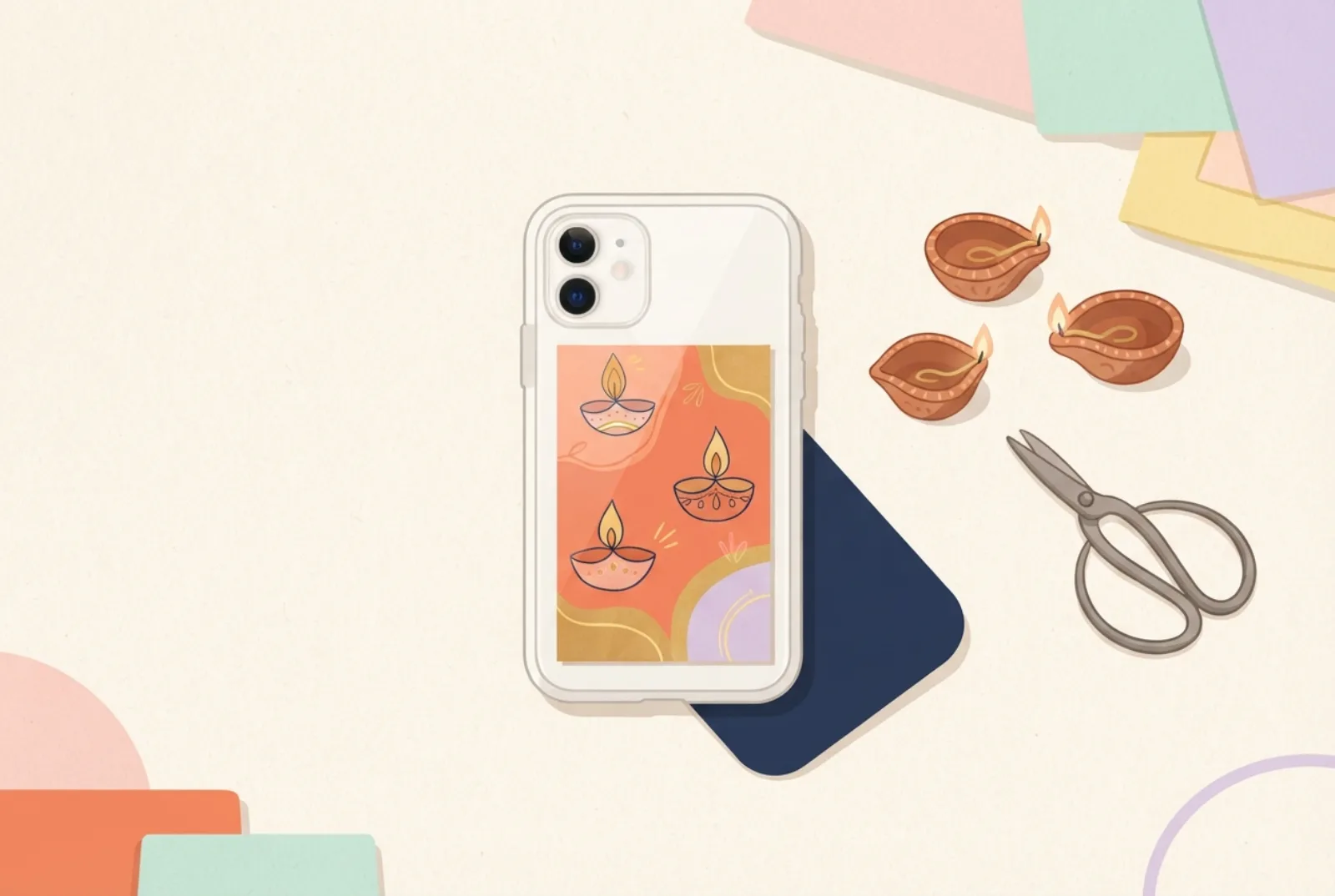
- Diwali is the Festival of Lights. In 2026 the main day, Lakshmi Puja, falls on 8 November according to Wikipedia, and dates can differ by region.
- Your own photos and drawings are the safest and most personal choice for an insert.
- The five-day layout below gives each day a small box you can colour in as the festival goes on.
- Diwali means different things to Hindus, Jains and Sikhs. Ask someone who celebrates to read your design if you can.
We do not have Diwali designs in the gallery yet, so every idea here uses tools you already have in the insert maker: a photo, the text tool, stickers or the Draw tool. Check the camera corner of your phone first, because it hides part of the top of any insert.
What Diwali is, in a few lines
Diwali, also called Dipavali, is known as the Festival of Lights. Wikipedia describes it as a festival celebrated by Hindus, Jains, Sikhs and some Newar Buddhists in Nepal, and says it falls in the lunisolar months of Ashvin and Kartika, roughly mid-October to mid-November. Wikipedia gives the name as coming from the Sanskrit dipavali, meaning “a row or series of lights”. (Sources at the end, checked 21 October 2026.)
The meaning depends on who you ask. According to Wikipedia, many Hindus remember Rama’s return to Ayodhya or Krishna’s victory over Narakasura, and honour Lakshmi, the goddess of prosperity; Jains mark the nirvana of Mahavira; Sikhs observe Bandi Chhor Divas, remembering Guru Hargobind’s release from prison. Both sources describe lighting small oil lamps called diyas and decorating floors with rangoli patterns, and Wikipedia also mentions feasts with sweets and greeting cards. The Western University blog says the festival takes place over five days, with the main celebrations on day three. This is a summary, and families and regions differ a lot, so use it as a starting point and not as a rulebook.
Pick an idea by effort
Times are rough estimates, not measured.
| Idea | Time | You need |
|---|---|---|
| Family photo with a greeting | 5 minutes | One photo |
| Photo of your lit diyas | 5 minutes | A photo taken at dusk |
| Greeting card from a child | 10 minutes | A drawing and a phone camera |
| Hand-drawn diya | 15 minutes | Pencils or gel pens |
| Rangoli-style pattern | 20 minutes | Coloured pencils, a ruler |
| Five-day layout | 15 minutes | Text tool or a pen |
8 Diwali ideas
- Family photo with a greeting. A tall crop, faces in the lower two thirds, and “Happy Diwali” in the handwritten font below the camera area. Make a photo insert.
- Your own lit diyas. A photo of the lamps you set out, taken at dusk. A steady hand or a prop helps in low light.
- A hand-drawn diya. A simple lamp shape with a flame, in warm colours on a dark blue or cream insert. See drawing ideas.
- A rangoli-style pattern. Dots and petals in a repeating pattern, drawn with a ruler. Wikipedia mentions rangoli floor designs as a Diwali custom; draw your own pattern and do not copy someone else’s artwork.
- A card made by a child. Photograph a handmade card flat in daylight and crop it to the phone shape.
- The five-day layout. Five small boxes, one per day of the festival (see the diagram below).
- A simple greeting. Large text on a plain warm background, such as “Shubh Deepavali” if that is a greeting you use. Check the spelling with someone who writes it.
- A gift for a friend. If a friend celebrates, make an insert with their photo and a greeting, and give it with a note. Check their phone model first. See gift ideas.
A five-day layout
Wikipedia lists five days for 2026: Dhanteras on 6 November, Naraka Chaturdashi on 7 November, Lakshmi Puja on 8 November, Govardhan Puja on 9 November and Bhai Dooj on 10 November. It also notes that regions count and name the days differently, and that the festival lasts five or six days depending on place. If your family follows other dates, change the labels. The insert below has one box per day, so a child can colour a box each evening.
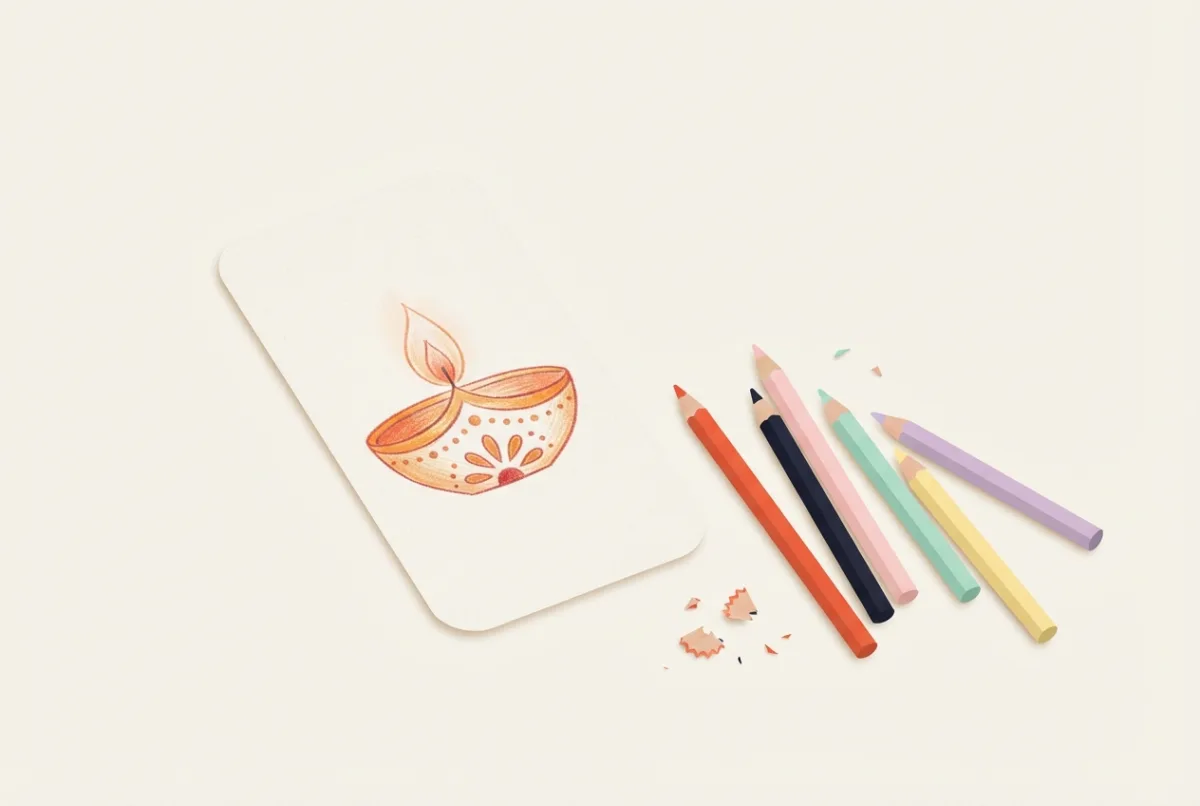
Draw a dot-and-petal pattern in four steps
Wikipedia mentions rangoli floor designs as a Diwali custom, and the Western University blog says they are colourful ground patterns, often at the entrance of a home. A simple pencil version for an insert uses a grid of dots. This method is ours: it is a drawing exercise, not a traditional recipe, so change it freely.
On a tall insert, repeat the pattern two or three times down the page, or use one large pattern at the bottom and keep the top clear for the camera.
Colours, symbols and care
- Keep it simple. Lamps, flames, dots and petals are easy to draw and look good at phone size. Warm oranges, golds and deep blues print well on photo paper.
- Use your own artwork. Do not copy another artist’s rangoli or card. Draw your own, or photograph something you made.
- Be thoughtful with sacred images. If you are not sure whether an image or text is appropriate on a phone case, ask someone who celebrates, or choose lights and patterns instead. We do not include images of deities.
- No licensed characters or brand logos.
- Avoid real flames near the insert. Paper burns. Photograph the lamps; do not put the insert near them.
Paper, printing and timing
- Use glossy photo paper for photos and the warm colours of Diwali. See the paper guide.
- Print at 100%. If it comes out too small, read how to print at true size.
- Cut around the camera hole with care; see how to cut the camera hole.
- Make the insert a few days ahead, so you can fix the size before the festival.
| When | What to do |
|---|---|
| Now to 1 November | Choose the idea and find the exact phone model. |
| 2 to 5 November | Print a plain-paper test and try it in the clear case. |
| 6 November | The five-day layout can start (Dhanteras, per Wikipedia). |
| 8 November | Lakshmi Puja, the main day in 2026 according to Wikipedia. Check your local calendar. |
Questions
When is Diwali in 2026?
Wikipedia gives 8 November 2026 as the main day (Lakshmi Puja), with the five days running from 6 to 10 November. Dates can differ by a day or by region, so check a calendar used by your community.
Is it appropriate to make a Diwali insert if I do not celebrate it?
For a friend or neighbour who celebrates, a thoughtful gift is usually welcome. Keep to simple, respectful motifs such as lamps and patterns, ask them if you are unsure, and avoid anything you do not understand.
Can I use a picture of a deity?
That is a personal and community decision, and we do not include such images. If it matters to you, ask someone in your community, or choose lamps and patterns.
What is a diya?
Wikipedia and a Western University blog describe diyas as small oil lamps lit in homes, temples and workplaces during Diwali. On an insert it is a simple lamp shape with a flame.
Where do I find a Diwali template for my phone?
We do not have a Diwali gallery yet. Choose your phone in the templates list. The size and camera cutout are the same all year; only the picture changes.
What do I do with the insert afterwards?
Swap it for another design, or keep the file and reprint it next year.
Sources
- Wikipedia: Diwali (2026 dates, the five days, meanings for Hindus, Jains, Sikhs and Newar Buddhists, customs), checked 21 October 2026.
- Western University (Canada), Thrive Online blog: Diwali, the Festival of Lights (2020; diyas, rangoli at the entrance, five days with the main celebrations on day three), checked 22 October 2026.