
Pressed flower phone case insert
Short answer: press small, thin flowers or leaves flat between paper under heavy books until fully dry, then arrange them on an insert cut to your phone’s size and slide it behind a clear case. The Royal Horticultural Society (RHS) gives about a week for simple flowers and two to four weeks for a school-style book press. Use only completely dry, thin material.
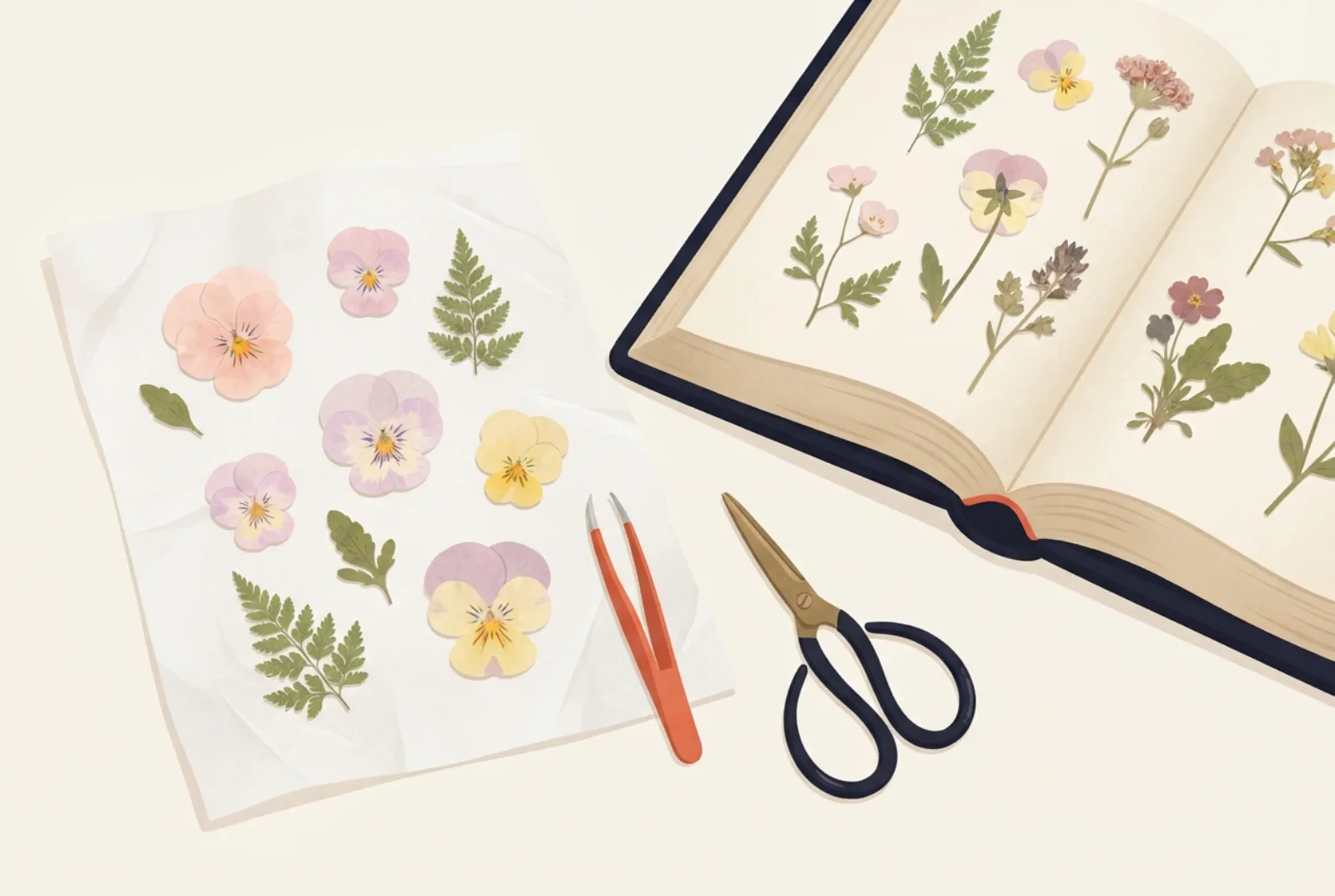
- Choose simple, flat flowers: pansies, primroses and small leaves are recommended by the RHS.
- Drying takes time: the RHS gives about a week for simple flowers and two to four weeks for the book method.
- Use only fully dry material. Moisture marks paper and phones.
- Keep it thin: if the case will not close, remove the thickest piece.
Choose the right plants
The RHS recommends simple, fairly flat flowers such as pansies and primroses, and small leaves, for pressing between scrap paper under books; it also suggests collecting on a dry day, later in the day once the morning dew has gone, and pressing the petals separately if a flower is thick. (RHS: how to dry flowers and foliage; RHS: pressing flowers and leaves.) Thick, fleshy flowers such as succulents and large roses hold moisture and are hard to press flat (our general knowledge, not an RHS claim). A phone insert is only about 70 × 150 mm, so choose a few small pieces rather than one big bloom. For an autumn version, see the Thanksgiving insert ideas, which include a leaf rubbing.
- Good choices: pansies, violas, primroses, small daisies, forget-me-nots, ferns, thin leaves, grasses.
- Hard to press flat: succulents, large roses, anything very thick or wet.
- Pick responsibly: use your own garden or a source you have permission from. Check local rules before picking wild plants, and wear gloves if you are unsure about a plant, because some irritate skin.
How to press them
- Open a heavy book near the middle or the back.
- Put two sheets of kitchen or tissue paper between the pages, lay the flowers on them and cover them with two more sheets.
- Close the book gently. Store it somewhere warm and dry, and add more heavy books on top if you can.
- Check after a few days and leave them until they no longer feel damp.
- Handle dry petals with tweezers. They tear easily.
How long does it take?
An iron can speed things up. The RHS school guide says to use low heat with no steam and rest the iron on each area for ten seconds: if the flower sizzles, moisture remains, and you repeat until the sizzling stops and the flower feels firm and dry. Never use steam.
Four ways to dry flowers, and which one suits an insert
The RHS describes four ways to dry flowers and foliage. Only one gives a flat result, which is what a phone case needs. The table summarises the RHS page (RHS: how to dry flowers and foliage); the last column is our own reasoning.
| Method | RHS says it suits | Time (RHS) | For an insert? |
|---|---|---|---|
| Pressing | Pansies, primroses, small leaves | About a week for simple flowers | Yes. It gives flat flowers |
| Air drying | Statice, grasses, yarrow, poppy seedheads | 2 to 3 weeks, sometimes longer | No: stems and heads stay three-dimensional |
| Silica gel | Hellebores, peonies, roses | Check every couple of days | Usually no: the flowers keep their shape and are thick |
| Glycerine | Box, beech, ferns (foliage) | Until the foliage feels leathery | Maybe for a flat leaf; it stays soft and slightly oily, so test first |
Book, wooden press or iron?
The RHS’s school-gardening guide describes three ways to press. Here they are side by side. (RHS: pressing flowers and leaves.)
| Method | You need | Time (RHS) | Good for |
|---|---|---|---|
| Heavy books | Three or four heavy hardbacks (over 500 pages work best), kitchen or tissue paper | 2 to 4 weeks | Anyone, no tools |
| Wooden press | Two boards, corrugated cardboard, newspaper, blotting paper, bolts and wing nuts or straps | 2 to 4 weeks | Pressing many flowers regularly |
| Iron (adults or older children) | An iron on low heat with no steam, baking or greaseproof paper | About ten seconds on each area, repeated until the sizzling stops | A quick result when you are short of time |
One tip in the RHS guide is worth repeating: for a better result, pull off and press each petal separately so it dries fully. For an insert, that gives you flat parts to arrange like a collage.
Arrange the flowers on the insert
Looking after pressed flowers
- Keep them dry. The RHS advises keeping dried displays away from damp rooms such as bathrooms, where they may go mouldy. A phone in a bathroom or a steamy kitchen is the same risk.
- Keep them out of direct sun. The RHS warns about strong sunlight for dried displays; for a phone, avoid leaving it on a sunny windowsill or car dashboard.
- Dust gently. The RHS suggests a hairdryer on a low heat to dust dried flowers. For an insert, lift pieces off with tweezers instead and blow softly on the paper.
- Start with good flowers. The RHS says drying will not improve a poor bloom, so choose the best ones.
Make the insert
- Print a light backdrop at your phone’s size in the insert maker. The cottagecore designs, the minimal ones or a cream sheet suit flowers well. Print at 100% on matte paper. Print guide.
- Cut the outline and the camera window. Camera-hole guide.
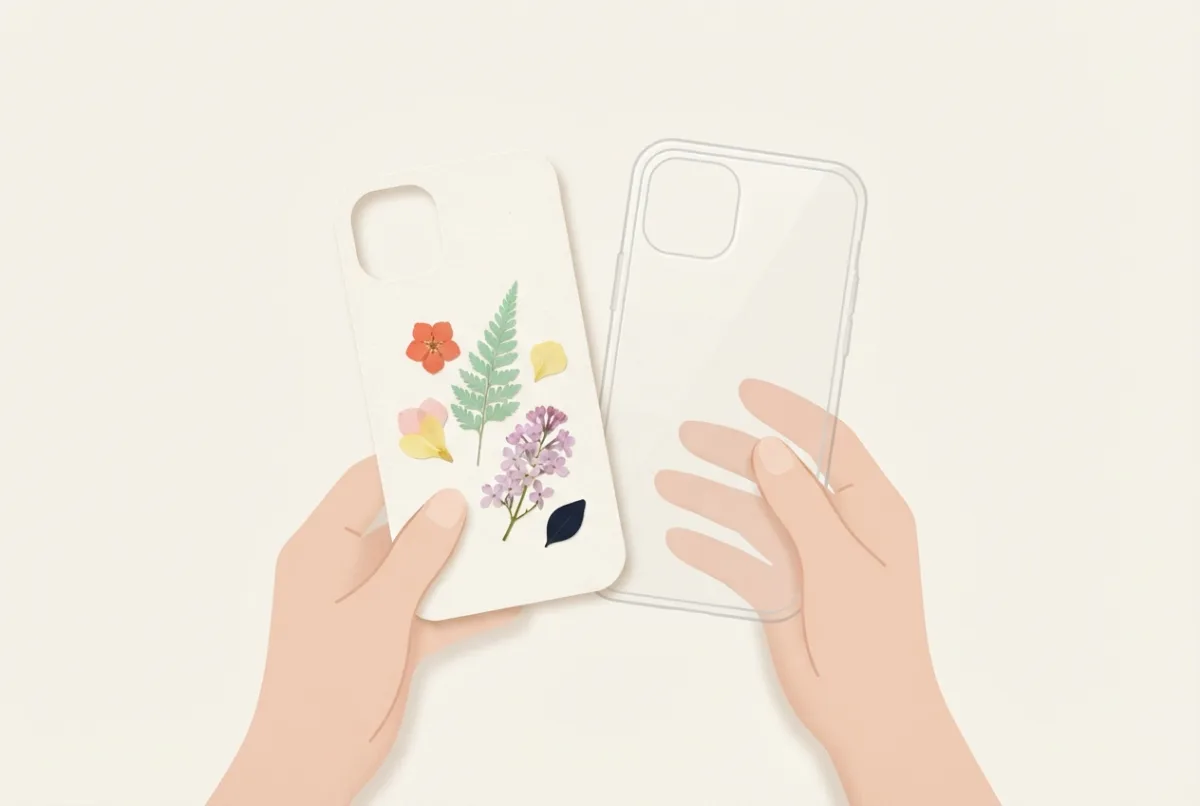
- Arrange the dry flowers on the insert, keeping them away from the camera corner and, as our suggestion, about 3 mm from the edges. Try three layouts: one sprig off-centre, a loose scatter, or a border down one side.
- Hold them in place with a tiny dab of glue stick or a small piece of tape on the stem. Do not coat the flower.
- Slide the insert in with the flowers facing the clear back. Close the case gently.
Keep it safe and flat
- Thin: the whole insert should stay thin. If the case will not close easily, remove the thickest flower. See fit problems.
- Dry: anything damp can mark the paper and the phone. Assemble only when everything feels papery.
- Stems and seeds: keep stems short and flat, and trim hard parts so nothing presses on the back of the phone.
- Fragile petals: small pieces may fall off with handling. Keep the case closed so loose pieces stay behind the back.
- Sun: pressed flowers can fade in strong sunlight over time. Keep the phone out of long direct sun.
- MagSafe and charging: flowers add thickness and moisture risk. Test the hold and charging; see MagSafe inserts.
No flowers? Print the look instead
If you do not have pressed flowers, a printed floral design gives a similar look without the fragility. See cottagecore inserts and the whole gallery.
Questions
Can I use fresh flowers?
No. Fresh flowers hold water, which marks the paper and the phone, and they rot. Only fully dried flowers.
Will pressed flowers scratch my phone?
Dry petals are soft, but stems and seeds can be hard. Keep stems short and flat, and trim hard parts.
How long does a pressed flower insert last?
It depends on the plant, the light and how much you handle it. Replace it when the colour fades or petals break up. You can swap the printed backdrop at any time.
Can I use dried flowers I did not press?
Only if they are flat. Air-dried flowers are often too thick or brittle for a phone case.
Can I use air-dried or silica-gel flowers?
The RHS describes both methods, but they keep the flower’s shape, so the result is usually too thick for a phone case. Pressing is the method that gives a flat flower. If you want a dried look without the thickness, press the petals separately.
Can I seal the flowers?
You can lay a thin sheet of clear paper over them, but anything glued or laminated adds thickness. The clear case already protects them.
Sources
- RHS: Pressing flowers and leaves (book method, two to four weeks, iron method, collecting on a dry day).
- RHS: How to dry flowers and foliage (pansies, primroses and small leaves; dry in about a week).
Find the template for your phone
Every guide works best with a true-size template for your exact model: iPhone templates, Samsung Galaxy templates, Google Pixel templates, iPad templates, or all phone models. Then open the insert maker to print it.