
Christmas card phone case insert
Short answer: a card-style insert is a tall sheet with a picture on top, a short message below and your name at the bottom, printed at your phone’s size and slid behind a clear case. Make it from a photo, a drawing or one of our Christmas designs, add a line in the handwritten font, and keep the picture away from the camera window. To reuse a real card, photograph it flat and crop it tall: most cards lose about a third of their width.
Looking for more than a card layout? See all Christmas phone case insert ideas.
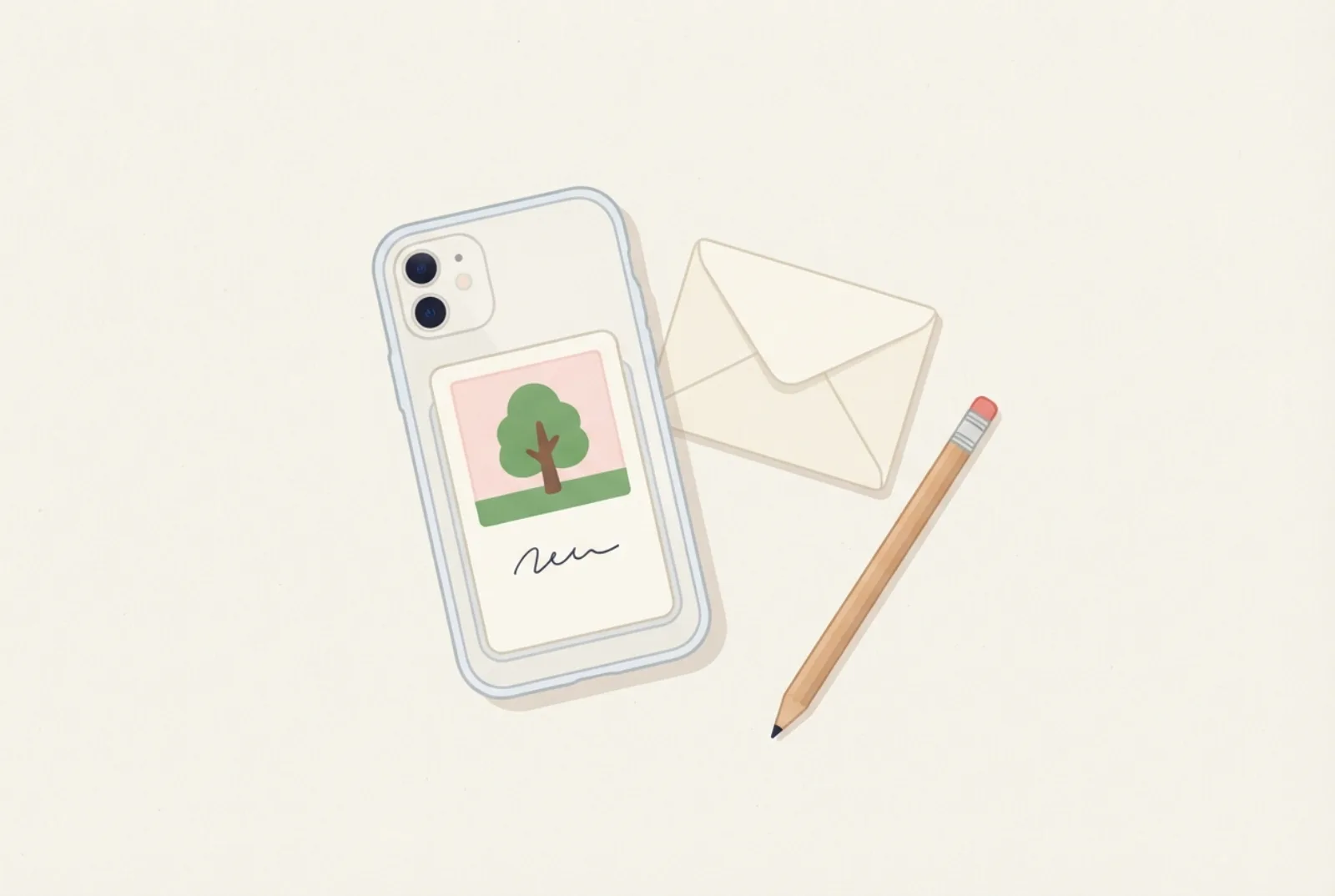
- A card-style insert has three zones: picture, message and signature. The camera corner is cut out.
- Phone inserts are about twice as tall as wide, so a landscape card loses most of its width when cropped.
- Keep the message to one short line, written below the picture and clear of the camera window.
- A flat insert fits an ISO DL envelope for every phone in our maker, and a C6 envelope for the smaller ones.
- Handmade cards have a long history; a drawn insert follows that tradition.
The three zones of a card-style insert
Four ways to make one
| Way | What you do | Time (our estimate) |
|---|---|---|
| A photo card | Crop a tall family or winter photo in the photo insert maker, add a line in the handwritten font | 10 minutes |
| A drawn card | Print a blank Christmas template, draw the picture at the top and write the message by hand | 20 to 40 minutes |
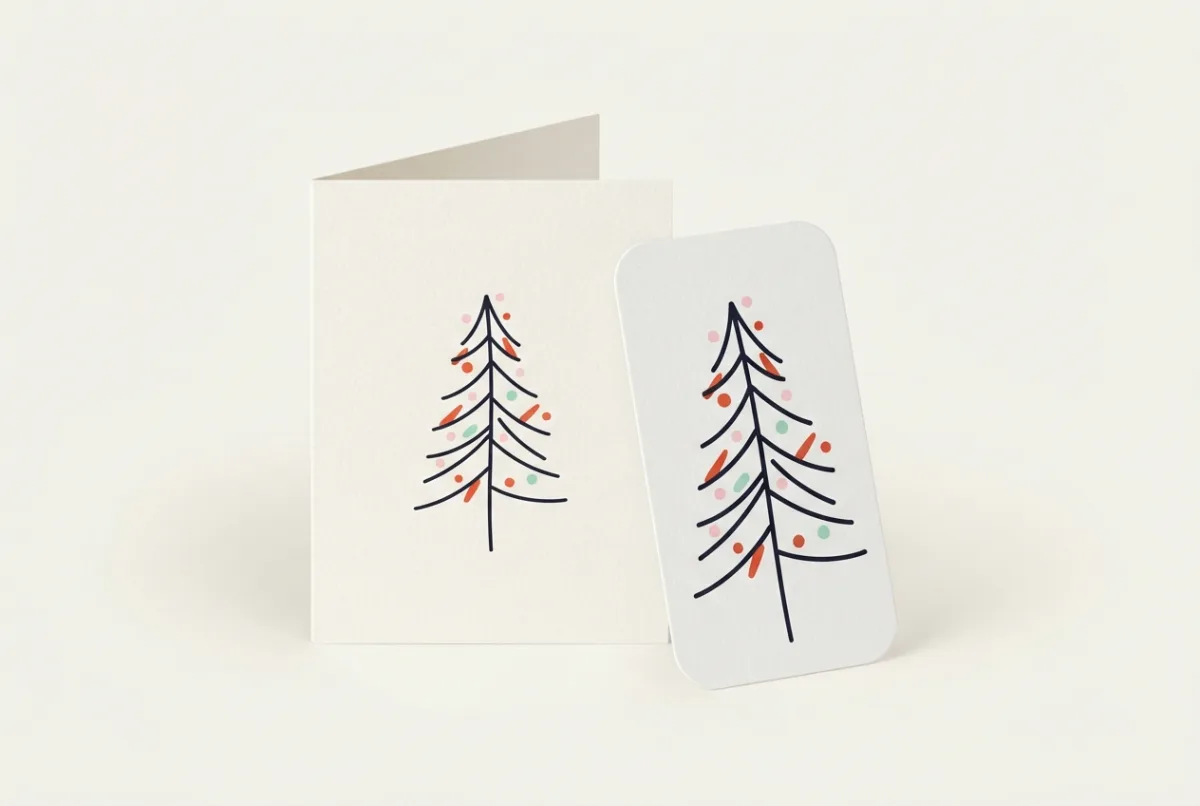
| A designed card | Open the Christmas night design in the maker, add a message with the text tool | 10 minutes |
| A real card | Photograph a card you already have and crop it (see below) | 10 minutes |
Turn a real card into an insert
- Lay the card flat by a window in even daylight, with no shadow across it.
- Photograph it straight from above, so the edges look straight.
- Upload the photo in the maker and drag it so the picture fills the frame.
- Check that nothing important sits under the camera window, then print on photo paper.
The shape of the card decides how much you keep. An insert is about 71.6 mm wide and 147.6 mm tall for an iPhone 16 (the manufacturer’s published size), so its width is about 0.485 of its height. This table shows what you keep when you crop a card to that shape. It is plain arithmetic.
| Card | Size (mm) | Width you keep at full height | Width lost |
|---|---|---|---|
| A6, portrait | 105 × 148 | 71.8 | 33.2 (32%) |
| 5 × 7 in, portrait | 127 × 178 | 86.3 | 40.7 (32%) |
| A5, portrait | 148 × 210 | 101.9 | 46.1 (31%) |
| Square card | 140 × 140 | 67.9 | 72.1 (51%) |
| A6, landscape | 148 × 105 | 50.9 | 97.1 (66%) |
So a portrait card works well, a square card crops to a narrow strip, and a landscape card is best used for a detail, not the whole card. If the whole card matters, put it on a plain backdrop at its real size instead.
What to write
A card needs a line, but a phone insert needs a short one. Aim for about 25 characters or fewer (our rule of thumb) and put it below the picture. These lines are original, so use them freely.
| For | Short lines |
|---|---|
| Family | “Merry Christmas, from us.” · “Home for the holidays.” · “Love, all of us.” |
| A friend | “Merry everything.” · “Glad you’re in my year.” · “Cheers to you.” |
| A colleague | “Happy holidays.” · “Thanks for the year.” · “Warm wishes.” |
| A partner | “My favourite season is you.” · “Another year, still us.” · “Merry first Christmas.” |
Use your own words or a public-domain verse; song lyrics and famous quotations are usually protected by copyright. This is general guidance, not legal advice.
A short history of Christmas cards
According to Wikipedia’s Christmas card article, the first commercial Christmas card was commissioned by Sir Henry Cole and designed by John Callcott Horsley in London in 1843, showing three generations of a family raising a toast; two batches totalling 2,050 cards were sold for a shilling each. Early British cards rarely showed winter or religious themes, favouring flowers, fairies and sentimental images. In 1873 the lithography firm Prang and Mayer began making cards for the British market and in 1874 started selling them in America, and by the 1880s Louis Prang was producing over five million cards a year. Postcards ended the era of elaborate Victorian cards, and cards with envelopes returned by the 1920s. The article also says that many people have made their own cards since the 19th century, out of necessity, for artistic reasons or to avoid commercialism. (Wikipedia: Christmas card.)
The idea is old enough that it is a good fit for a handmade insert: a drawn picture with a short message is close to the homemade cards the article describes.
Give it in an envelope
A flat insert slides into a card envelope. Wikipedia’s envelope article lists ISO DL as 110 × 220 mm and C6 as 114 × 162 mm. (Wikipedia: Envelope.) Comparing those with the phone sizes in our maker, with 3 mm to spare on each side, DL fits all 98 phones and C6 fits 37 of them (our arithmetic). Write the phone model on the back in pencil, and add a note: “Slide this behind your clear case.” For a gift, check the phone model first; see gift ideas for how.
A simple timeline
This plan is ours, not from a source.
| When | What to do |
|---|---|
| Late November | Choose the picture and find the recipient’s exact phone model. |
| First week of December | Print a plain-paper test and try it in a clear case. |
| Mid December | Print on photo paper, write the model on the back and wrap. |
| Christmas week | Give it. Keep the file to reprint. |
For more festive ideas, see our main Christmas phone case insert ideas.
Questions
What is a card-style insert?
A phone-shaped sheet laid out like a small card: a picture, a short message and a name. It slides behind a clear case, so it works like a card you carry.
Can I use a card I received?
For your own use, photograph it flat and crop it. If someone else made the artwork, ask them before you share a copy, and avoid commercial use.
Why is my card cropped so much?
An insert is about twice as tall as it is wide, so cards that are wider lose more. The crop table above shows how much.
Where does the message go?
Below the picture, away from the camera window, in one short line. The maker shows the camera window while you place the text.
Which envelope fits?
ISO DL fits all 98 phones in our maker with 3 mm to spare; C6 fits 37 of them. Check your own phone’s size.
Can I print it at a shop?
Yes. Download the PDF and ask the shop to print at 100% with no scaling on photo paper.
Sources
- Wikipedia: Christmas card (first commercial card 1843, Prang and Mayer, handmade cards, return of cards with envelopes).
- Wikipedia: Envelope (ISO DL 110 × 220 mm and C6 114 × 162 mm).
- Phone sizes: this site’s size table, from manufacturers’ published dimensions.
Find the template for your phone
Every guide works best with a true-size template for your exact model: iPhone templates, Samsung Galaxy templates, Google Pixel templates, iPad templates, or all phone models. Then open the insert maker to print it.